So, I will move to Amersfoort this weekend and I'm terribly busy with my new job (but it's also really interesting and I'm making many mistakes so I learn a lot).
And it shows - I haven't blogged in a week, even though there was a lot to blog about...
For example, I'm sad to tell you guys Putsy, my little dwarfhamster, passed away last week. He had an infection, probably indirectly caused by the cat who threw the cage on it's side. Putsy most likely got smashed somehow, and the vet was unable to get her to drink anti-biotics. She already went into a state of hibernation, and died the next day (just before I left for Linux-Info-Tage in Dresden). I was a bit sad while driving to Dresden, but meeting the guys there made up for it.
Speaking off Dresden, I gave a talk at Linux-Info-Tage. Here a little (german) writeup about it (including a higher quality version of the dolphin animations movie which also is on Youtube). Ah, and Kubuntu-de.org also wrote about the Dresden event. Here the picture of me which I consider best. Even though this one doesn't show how I did actually shave, like I promised.
And where were you, Merlin?
09 November, 2007


30 October, 2007
Konsole performance
I had a discussion about the speed of Konsole with some Gnome users at a CodeYard meeting. Some testing on the spot revealed gnome-terminal was much faster. So I tried to test some stuff at home, too - see if anything has changed with KDE 4.
Well, yes, Konsole got almost twice as fast - still slower than gnome-terminal, though.
[root@wietbak log]# time cat messages.log.4
(lots of output)
real 0m1.923s (Konsole KDE 3)
real 0m1.077s (Konsole KDE 4)
real 0m0.412s (gnome-terminal 2.18)
But there are differences - some files show different results.
Take the output of another file, dunno what it's supposed to be but it's in /var/log, too, and contains many weird characters like these: ���E�Ms� �
[root@wietbak log]# time cat btmp
real 0m1.030s (gnome-terminal 2.18)
real 0m0.819 (Konsole KDE 4)
real 0m0.711s (Konsole KDE 3)
So for this file, the result is exactly the opposite, though the differences are much smaller.
Weird, weird.
Let's cat all files in /var/log, then, see what the overall scores are:
[root@wietbak log]# time cat *
real 0m10.797s (Konsole KDE 4)
real 0m18.940s (Konsole KDE 3)
real 0m6.524s (gnome-terminal 2.18)
real 0m16.423s (xterm)
For those who want to know how xterm does... Besides looking horribly (no anti-aliassing, and flashes horribly while scrolling), it sucks only slightly less than Konsole from KDE 3 in terms of speed.
Anyway, that confirms the first results. Konsole got almost twice as fast, but gnome-terminal is still a lot faster ;-)
Now of course Konsole kicks gnome-terminal in terms of features, but speed matters too ;-)
I'm not unhappy with the current speed (hey, twice as fast, that's good!) but there apparently is room for improvement. So let's see what the future (KDE 4.1?) brings...
Well, yes, Konsole got almost twice as fast - still slower than gnome-terminal, though.
[root@wietbak log]# time cat messages.log.4
(lots of output)
real 0m1.923s (Konsole KDE 3)
real 0m1.077s (Konsole KDE 4)
real 0m0.412s (gnome-terminal 2.18)
But there are differences - some files show different results.
Take the output of another file, dunno what it's supposed to be but it's in /var/log, too, and contains many weird characters like these: ���E�Ms� �
[root@wietbak log]# time cat btmp
real 0m1.030s (gnome-terminal 2.18)
real 0m0.819 (Konsole KDE 4)
real 0m0.711s (Konsole KDE 3)
So for this file, the result is exactly the opposite, though the differences are much smaller.
Weird, weird.
Let's cat all files in /var/log, then, see what the overall scores are:
[root@wietbak log]# time cat *
real 0m10.797s (Konsole KDE 4)
real 0m18.940s (Konsole KDE 3)
real 0m6.524s (gnome-terminal 2.18)
real 0m16.423s (xterm)
For those who want to know how xterm does... Besides looking horribly (no anti-aliassing, and flashes horribly while scrolling), it sucks only slightly less than Konsole from KDE 3 in terms of speed.
Anyway, that confirms the first results. Konsole got almost twice as fast, but gnome-terminal is still a lot faster ;-)
Now of course Konsole kicks gnome-terminal in terms of features, but speed matters too ;-)
I'm not unhappy with the current speed (hey, twice as fast, that's good!) but there apparently is room for improvement. So let's see what the future (KDE 4.1?) brings...
28 October, 2007
On vision and Future
The talk I gave at the Dutch Ubuntu Release party marked a point in time where my thoughts about the Vision and Future of KDE have become solid enough to write about them. Of course, many have preceded me - like Aaron, Troy and Wade. And I have been greatly influenced by my research in the area of Social Innovation and Open Innovation at the Dutch research institute TNO. So this doesn't come out of nowhere at all, I've just merged and aligned these different ideas somewhat.

This image by Wade is quite true. Even though a community generally doesn't have the focus a company can enforce from its employees, KDE has a vision. We want to go somewhere, as a community. Not everyone has the same ideas, sure. But out of all these different individuals and sub-communities within KDE, with their own opinions, plans and roadmaps, a big picture appears.
I don't claim I can express exactly what KDE wants for the future - I'm just a member of this community. I have my own ideas, and I'm influenced by my own knowledge about many things - or lack there off. But ideas grow. What KDE is growing into might never have been imagined by anyone who started on this journey. Yet I think the implications of it can be quite clear.
The most simple incarnation of the plan for KDE 4 is "improving our framework". It means we are going to make the KDE libraries better. Add new functionality, improve the existing stuff.
Aaron Seigo has been more verbose, speaking about making it easier to join KDE, to attract new developers. By improving documentation (techbase), but also by making KDE technology available to more people. It is one of the main ideas behind the development of Plasma, a new widget-based framework which replaces the desktop and panels in KDE 4. It is easy to develop for plasma, because it offers a lot of high-level functionality. Without having to worry about the complexities of data gathering, the writer of an applet can focus on the representation - so more bright ideas can be expanded upon. Meanwhile Kross, the new library in KDE 4, allows application developers to support more than just one language for writing extensions and plugins. If you're not fluent in Python, you can use Javascript, or Ruby... The result is more people can contribute - which leads to more innovation.
Innovation is one of my biggest interests (professionally as well as personal), and I have always enjoyed the innovative culture in KDE. We're open to ideas, very open. Of course, this is a property of most F/OSS projects, Raymond knew that already. This has been noticed in management circles too.
So, there's a new management trend in town: Open Innovation. Around the world, MT's are trying to figure out how to take advantage of it. Open Innovation is about opening up to and working closely with customers and suppliers to facilitate innovation and new ideas.
And it works. FOSS has proven to be not just a superior development model for software, but the freedom is also conductive to innovation. Of course, this is what every good open source project does. We're a natural at that.
But we are doing more. Yes, the work by Aaron (and many others) makes it easier to contribute. The improvements to the KDE libraries, and the support for more and easier languages to write full applications in does the same. Yet, there is another big thing coming which will help us to become more innovative: The Pillars of KDE 4. These new technologies we are introducing in KDE 4 like Decibel (communication), Phonon (multimedia) and Akonadi (PIM data) will increase our innovative capacity. Which is, to quote myself: "the capacity of an organization to generate and use ideas (inventions) to perform effectively" [1].
What is an invention? It's simple. Inventions are the connection of existing ideas and technologies into a new one. Now imagine. Providing people with bright ideas with incredibly powerful, high level components they can connect and combine in any way they want - all this within an atmosphere highly conductive to innovation. No management, nobody telling you what to do, no paperwork. No limitations.
See where this is going? We are creating a perfect opportunity for the Free Desktop to leap ahead of the competition. Apple and Microsoft won't be able to keep up with us... Ever.
Does every KDE developer realize the full potential of this? Not all of them, maybe. But you'd be surprised how many grasp at least a big part of this future. And not only our own people, but the Free Software community at large is aware something big is going on. We're already the second-largest FOSS project, but we're growing like crazy - new developers join us almost daily.
High expectations for KDE 4. No, not for 4.0 - I think most people already understand 4.0 will just be the beginning. Not terribly stable. Nor fully complete. But it will have these foundations in place and it will enable us to start innovating.
Boy, am I looking forward to the future!
[1] my unfinished paper about "The effect of psychological safety and climate for initiative on the effectiveness of explorative and exploitative innovation" (translated).

This image by Wade is quite true. Even though a community generally doesn't have the focus a company can enforce from its employees, KDE has a vision. We want to go somewhere, as a community. Not everyone has the same ideas, sure. But out of all these different individuals and sub-communities within KDE, with their own opinions, plans and roadmaps, a big picture appears.
I don't claim I can express exactly what KDE wants for the future - I'm just a member of this community. I have my own ideas, and I'm influenced by my own knowledge about many things - or lack there off. But ideas grow. What KDE is growing into might never have been imagined by anyone who started on this journey. Yet I think the implications of it can be quite clear.
The most simple incarnation of the plan for KDE 4 is "improving our framework". It means we are going to make the KDE libraries better. Add new functionality, improve the existing stuff.
Aaron Seigo has been more verbose, speaking about making it easier to join KDE, to attract new developers. By improving documentation (techbase), but also by making KDE technology available to more people. It is one of the main ideas behind the development of Plasma, a new widget-based framework which replaces the desktop and panels in KDE 4. It is easy to develop for plasma, because it offers a lot of high-level functionality. Without having to worry about the complexities of data gathering, the writer of an applet can focus on the representation - so more bright ideas can be expanded upon. Meanwhile Kross, the new library in KDE 4, allows application developers to support more than just one language for writing extensions and plugins. If you're not fluent in Python, you can use Javascript, or Ruby... The result is more people can contribute - which leads to more innovation.

Innovation is one of my biggest interests (professionally as well as personal), and I have always enjoyed the innovative culture in KDE. We're open to ideas, very open. Of course, this is a property of most F/OSS projects, Raymond knew that already. This has been noticed in management circles too.
So, there's a new management trend in town: Open Innovation. Around the world, MT's are trying to figure out how to take advantage of it. Open Innovation is about opening up to and working closely with customers and suppliers to facilitate innovation and new ideas.
And it works. FOSS has proven to be not just a superior development model for software, but the freedom is also conductive to innovation. Of course, this is what every good open source project does. We're a natural at that.
But we are doing more. Yes, the work by Aaron (and many others) makes it easier to contribute. The improvements to the KDE libraries, and the support for more and easier languages to write full applications in does the same. Yet, there is another big thing coming which will help us to become more innovative: The Pillars of KDE 4. These new technologies we are introducing in KDE 4 like Decibel (communication), Phonon (multimedia) and Akonadi (PIM data) will increase our innovative capacity. Which is, to quote myself: "the capacity of an organization to generate and use ideas (inventions) to perform effectively" [1].
What is an invention? It's simple. Inventions are the connection of existing ideas and technologies into a new one. Now imagine. Providing people with bright ideas with incredibly powerful, high level components they can connect and combine in any way they want - all this within an atmosphere highly conductive to innovation. No management, nobody telling you what to do, no paperwork. No limitations.
See where this is going? We are creating a perfect opportunity for the Free Desktop to leap ahead of the competition. Apple and Microsoft won't be able to keep up with us... Ever.
Does every KDE developer realize the full potential of this? Not all of them, maybe. But you'd be surprised how many grasp at least a big part of this future. And not only our own people, but the Free Software community at large is aware something big is going on. We're already the second-largest FOSS project, but we're growing like crazy - new developers join us almost daily.
High expectations for KDE 4. No, not for 4.0 - I think most people already understand 4.0 will just be the beginning. Not terribly stable. Nor fully complete. But it will have these foundations in place and it will enable us to start innovating.
Boy, am I looking forward to the future!
[1] my unfinished paper about "The effect of psychological safety and climate for initiative on the effectiveness of explorative and exploitative innovation" (translated).
27 October, 2007
accelerated rendering
Of course we have some experts in this area in the KDE community (zack is well known, but I wouldn't forget about Mosfet or the people working on KWin.
Now my understanding of this stuff (being not a developer) is always very limited - which does nothing to lower my interest in them... So when I read this blog on the gnome planet, I found it very interesting. I mean, it has pretty pictures, you know... And hardware accelerated rendering, preferably using openGL for everything (or at least more than we do now) is something I'd love to see - it really sounds like a big thing in terms of performance ;-)
Now the person who wrote this blog isn't very positive about this, but I agree with some of the comments there - OpenGL probably won't go away. Or would it be possible to integrate it with toolkits? This blog by Daniel Molkentin talks about using just the normal Qt api, yet the drawing goes through OpenGL. Sounds like neat, but what about all the other drawing in KDE/Qt?
The point of this blog is mostly that I haven't read about lower-level stuff like this for a while in the KDE blogosphere, and I'd love to see that change ;-)
How's the status of Arthur? Animations KDE4 are still kind'a disappointing in some areas - at first I blamed compositing (and it does make matters slightly worse, yes, but just slightly). Take the run dialog - it has an animation when you click options. Lovely, but it never works smooth, even the 100th time (you'd say it has cached stuff, and it has, but it's not enough). It's not just having to resize the window (even though that's bad), but even after that it's not exactly smooth.
And the background gradient in Oxygen has the disadvantage you often see a plain background flashing when resizing or animating things. As I see the CPU usage max out, I wonder if the GPU is used for any of these things - and if not, why not? Where's the bottleneck? X, Qt, other infrastructural stuff, or can't the GPU help at all?
So, who's involved in these things, and willing to write about them - what can we expect for KDE 4.0 and the future? Will these things be solved, is 3D hardware acceleration gonna help us anytime soon? When I see the animations in Vista - they're very smooth, and CPU usage keeps low, so it seems to me they've got the issue solved, haven't they?
Now my understanding of this stuff (being not a developer) is always very limited - which does nothing to lower my interest in them... So when I read this blog on the gnome planet, I found it very interesting. I mean, it has pretty pictures, you know... And hardware accelerated rendering, preferably using openGL for everything (or at least more than we do now) is something I'd love to see - it really sounds like a big thing in terms of performance ;-)
Now the person who wrote this blog isn't very positive about this, but I agree with some of the comments there - OpenGL probably won't go away. Or would it be possible to integrate it with toolkits? This blog by Daniel Molkentin talks about using just the normal Qt api, yet the drawing goes through OpenGL. Sounds like neat, but what about all the other drawing in KDE/Qt?
The point of this blog is mostly that I haven't read about lower-level stuff like this for a while in the KDE blogosphere, and I'd love to see that change ;-)
How's the status of Arthur? Animations KDE4 are still kind'a disappointing in some areas - at first I blamed compositing (and it does make matters slightly worse, yes, but just slightly). Take the run dialog - it has an animation when you click options. Lovely, but it never works smooth, even the 100th time (you'd say it has cached stuff, and it has, but it's not enough). It's not just having to resize the window (even though that's bad), but even after that it's not exactly smooth.
And the background gradient in Oxygen has the disadvantage you often see a plain background flashing when resizing or animating things. As I see the CPU usage max out, I wonder if the GPU is used for any of these things - and if not, why not? Where's the bottleneck? X, Qt, other infrastructural stuff, or can't the GPU help at all?
So, who's involved in these things, and willing to write about them - what can we expect for KDE 4.0 and the future? Will these things be solved, is 3D hardware acceleration gonna help us anytime soon? When I see the animations in Vista - they're very smooth, and CPU usage keeps low, so it seems to me they've got the issue solved, haven't they?
25 October, 2007
Colors again
A bit more work went into the Colors configuration, and imho Matthew Woehlke is doing a great job there. Today I played a little with the 'contrast' slider there, which gave the following screenshots, starting with Oxygen's own colorscheme, and then the 'Midnight Meadow' scheme.
Oxygen Low Contrast

Oxygen High Contrast

Yeah, not a huge difference. Personally, I prefer the 'Beos' color scheme, here in high contrast:

Here we have Midnight Meadow:
low contrast

medium contrast

high contrast

And last but not least, about Plasma performance. Some time ago, KNewsTicker was ported. Now there is a discussions going on about the release status on the KDE development mailinglist, and the KNewsTicker developer argued Plasma performance was bad - his applet used 15% on a 2 ghz Core2Duo, while just scrolling some text. Well - either he fixed the performance issue, he had a configuration problem, or someone else did something cool - but I can't reproduce it at all:
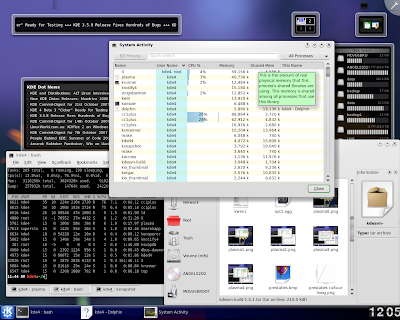
Further complaints about plasma performance (high cpu usage when moving plasmoids around) lead to Aaron testing the difference between KDesktop in KDE 3 and Plasma in KDE 4 - KDesktop used 3 times the cpu for moving an icon than plasma for moving a (transparant, svg, good looking) plasmoid... And to finish the 'performance sucks' argument off really well, Aaron mentioned there still is a lot of lowhanging fruit to fix, and Qt 4.4 is gonna speed things up a lot. Well, if Plasma performs as good as KDesktop with superkaramba, you won't hear me complaining (it does a LOT more). And it really looks it does - not just from Aaron's comments. Try KDesktop and Superkaramba with a few applets and be shocked (and that's not just superkaramba, all applet things in linux suck in terms of cpu usage - looks like Plasma is soon going to be the most sane implementation available).
BTW - see how cool KDE 4 looks ;-)
This is svn from a few hours ago, so the latest & greatest. And after playing with it for some minutes, I must say the main reason I don't switch fully to KDE 4 is because I installed it as a separate user, and I would have to migrate it to my current account or migrate my data to the other account ;-)


Yeah, not a huge difference. Personally, I prefer the 'Beos' color scheme, here in high contrast:

Here we have Midnight Meadow:


And last but not least, about Plasma performance. Some time ago, KNewsTicker was ported. Now there is a discussions going on about the release status on the KDE development mailinglist, and the KNewsTicker developer argued Plasma performance was bad - his applet used 15% on a 2 ghz Core2Duo, while just scrolling some text. Well - either he fixed the performance issue, he had a configuration problem, or someone else did something cool - but I can't reproduce it at all:

Further complaints about plasma performance (high cpu usage when moving plasmoids around) lead to Aaron testing the difference between KDesktop in KDE 3 and Plasma in KDE 4 - KDesktop used 3 times the cpu for moving an icon than plasma for moving a (transparant, svg, good looking) plasmoid... And to finish the 'performance sucks' argument off really well, Aaron mentioned there still is a lot of lowhanging fruit to fix, and Qt 4.4 is gonna speed things up a lot. Well, if Plasma performs as good as KDesktop with superkaramba, you won't hear me complaining (it does a LOT more). And it really looks it does - not just from Aaron's comments. Try KDesktop and Superkaramba with a few applets and be shocked (and that's not just superkaramba, all applet things in linux suck in terms of cpu usage - looks like Plasma is soon going to be the most sane implementation available).
BTW - see how cool KDE 4 looks ;-)
This is svn from a few hours ago, so the latest & greatest. And after playing with it for some minutes, I must say the main reason I don't switch fully to KDE 4 is because I installed it as a separate user, and I would have to migrate it to my current account or migrate my data to the other account ;-)
22 October, 2007
KDE 4 - does it work or not?
After a few blogs which where rather positive, we're now also seeing blogs and comments much more negative (I don't feel like linking to them, sorry).
Aside from some speed issues (which I don't see, frankly KDE 4 is clearly faster here in many aspects - see my previous blog), 90% of the complaints is about the state of Plasma
Now I agree Plasma is a big thing, important for KDE - but judging the whole of KDE by the part which is least finished - I think that's unfair. And to be honest, 90% of commments about Plasma are about the panel with the still-very-basic taskbar and the missing menu. The menu still is in playground (could be it was just moved into kdebase, btw) and well, yes, the taskbar - it's not very ready either.
But come on. Think about it. You're complaining about 10% of 10% of KDE 4. Actually, much less, as I've made up these numbers :D
So how much time would it take to write a decent panel, provided the current state? And Plasma will still see a lot of work, it's not frozen yet, unlike the rest of KDE. I'd rather see everyone trying and talking about all the new good stuff instead of complaining about the almost-last portion of KDE still in flux...
When I show people the state of Plasma, they're like "hmm, that's not good". So I then proceed to show the Edu and Games, cheers them right up. And there is Dolphin, Ksysguard, Gwenview, Okular, Kolourpaint, KRDC, Konsole - all those apps which have seen so many improvements. Or these small things, like the file dialog, the character selection dialog, the shortcut dialog... I don't hear anyone raving about those. Is that just because they COULDN'T get past the missing menu and not-so-great taskbar applet? Please...
We should be realistic (KDE4 won't be perfect, and will have regressions) but all this complaining doesn't do much good either. Feel free to report bugs for those things which are supposed to be finished (I just emailed the kwin developers about the not-working window-shortcut feature). And join those working on the things still not ready. And complain to your mum.
Take care.
Aside from some speed issues (which I don't see, frankly KDE 4 is clearly faster here in many aspects - see my previous blog), 90% of the complaints is about the state of Plasma
Now I agree Plasma is a big thing, important for KDE - but judging the whole of KDE by the part which is least finished - I think that's unfair. And to be honest, 90% of commments about Plasma are about the panel with the still-very-basic taskbar and the missing menu. The menu still is in playground (could be it was just moved into kdebase, btw) and well, yes, the taskbar - it's not very ready either.
But come on. Think about it. You're complaining about 10% of 10% of KDE 4. Actually, much less, as I've made up these numbers :D
So how much time would it take to write a decent panel, provided the current state? And Plasma will still see a lot of work, it's not frozen yet, unlike the rest of KDE. I'd rather see everyone trying and talking about all the new good stuff instead of complaining about the almost-last portion of KDE still in flux...
When I show people the state of Plasma, they're like "hmm, that's not good". So I then proceed to show the Edu and Games, cheers them right up. And there is Dolphin, Ksysguard, Gwenview, Okular, Kolourpaint, KRDC, Konsole - all those apps which have seen so many improvements. Or these small things, like the file dialog, the character selection dialog, the shortcut dialog... I don't hear anyone raving about those. Is that just because they COULDN'T get past the missing menu and not-so-great taskbar applet? Please...
We should be realistic (KDE4 won't be perfect, and will have regressions) but all this complaining doesn't do much good either. Feel free to report bugs for those things which are supposed to be finished (I just emailed the kwin developers about the not-working window-shortcut feature). And join those working on the things still not ready. And complain to your mum.
Take care.
Subscribe to:
Posts (Atom)